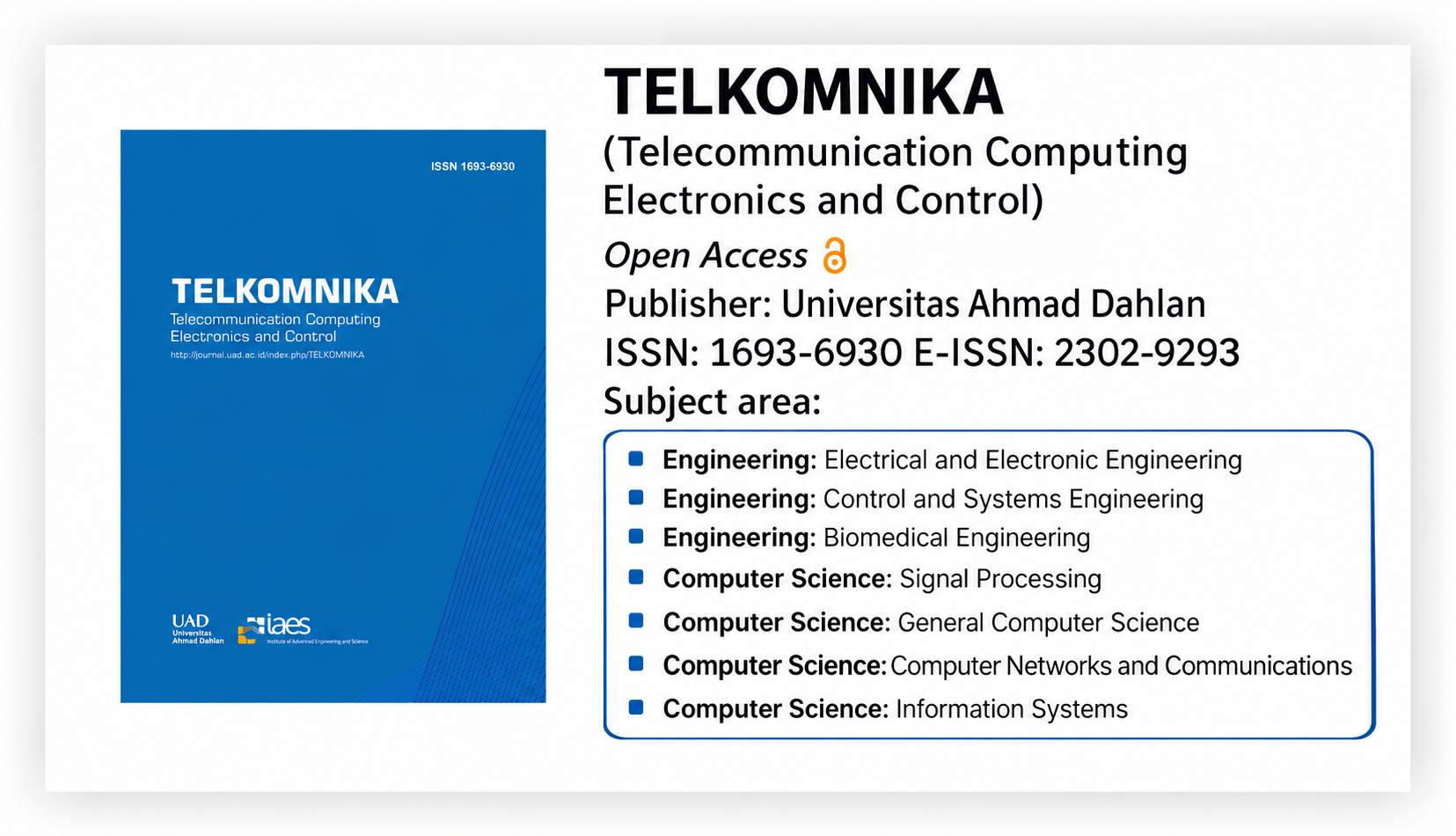
TELKOMNIKA (Telecommunication, Computing, Electronics and Control) ISSN:
1693-6930,
e-ISSN:
2302-9293
is a peer-reviewed scientific journal published by
Universitas Ahmad Dahlan (UAD).
The journal aims to publish high-quality research articles that report significant
advances in electrical and electronic engineering, computer science, and their
interdisciplinary applications. TELKOMNIKA welcomes original contributions
addressing emerging theories, methods, technologies, systems, and practical
applications that advance knowledge and innovation in engineering and computing.
The journal provides a forum for researchers, academics, and practitioners to
disseminate significant developments in telecommunication, computing, electrical
and electronics, instrumentation, control, and related information and
communication technologies.
The journal covers subject areas including engineering: electrical and
electronic engineering, control and systems engineering, and biomedical
engineering; as well as computer science: signal processing, general computer
science, computer networks and communications, and information systems. Within
these areas, TELKOMNIKA welcomes research on electrical and electronic systems,
intelligent control and automation, instrumentation, biomedical technologies
and systems, signal processing and analysis, telecommunications and computer
networks, communication systems, information systems, computing technologies,
and related emerging technologies. The journal particularly values research
that connects theoretical advances with system development, experimental
validation, and practical applications, contributing to intelligent, connected,
and sustainable technological systems. This journal holds accreditation from
the National Journal Accreditation (ARJUNA) under Indonesia's Ministry of
Education, Culture, Research, and Technology. It has been granted
First Grade status, or
Peringkat 1, as per Decree No. 169/E/KPT/2024, dated
1 October 2024. This recognition emphasises the journal's commitment to
upholding high academic standards and promoting knowledge advancement within
its disciplines. First published in 2003, the journal initially operated as a
bimonthly publication and has been releasing six issues per year since 2018.
The quality and credibility of the articles published in its pages reflect the
journal's commitment to research integrity, scientific rigor, and meaningful
contributions to engineering and computing.
A submitted paper should be original and not have been presented or published previously. Submission for publication in this journal presumes that the paper is not being considered for publication elsewhere and is not under review by any other publication. To maintain the highest publishing standards, all articles go through a thorough evaluation process while following all ethical guidelines. The TELKOMNIKA Editors strictly reviews the suitability and originality of manuscripts for publication. Our editors maintain research transparency, assess manuscripts for scientific value, ensure that content is free from any manifestations of discrimination, and evaluate information objectively without any conflict of interest. Publication integrity is one of the principle responsibilities we take on.
Authors should submit only papers that have been carefully proofread and polished. Manuscripts are accepted with the understanding that they are an original or extended version of previously published papers in conferences and/or journals, and that, if the work received an official sponsorship, it has been duly released for open publication. Before submitting, please ensure that you prepare your paper using the journal paper template. For the writing format and style, the authors should consult the TELKOMNIKA Journal, which they can download and use as a template for their initial manuscript submission in either
DOCX or LATEX
format. This will ensure fast processing and publication. We will not process any papers that do not meet the requirements outlined in the author guidelines. If you have any problems with the online submission, please send an email to telkomnika [at] ee.uad.ac.id (subject: Your Name: Problem with Online Submission) and cc: telkomnika [at] uad.ac.id.
| Effectiveness of mobile and web-based telecommunication in hemodialysis care: a systematic review |
PDF
|
|
Ari Devianto, Hapsari Peni Agustin Tjahyaningtijas, Lusia Rakhmawati, Nurhayati Nurhayati, Fista Utami, Muhammad Nasar, Hidayatul Khasanah |
1869-1883 |
| Adaptive OFDM/OTFS switching for high-mobility wireless communications |
PDF
|
|
Nessrine Smaili, Dihia Amani, Razaoui Feriel, Mustapha Djeddou |
1915-1927 |
| Longitudinal k-means clustering for socio-economic profiling of Indonesian regions |
PDF
|
|
Md Wira Putra Dananjaya, I Gusti Ngurah Darma Paramartha, Made Ari Riska Dayanti, Caren Angellina Mimaki |
1976-1985 |
| VeiLight-Net: a lightweight CNN architecture for real-time finger vein recognition on embedded systems |
PDF
|
|
Abdelhalim Hazzem, Lahcene Ziet, Imane Kouadra, Abd-ettouab Manallah, Anfal Rouabhi, Tewfik Bekkouche |
1995-2011 |
| Decomposition-aware recurrent fusion for particulate matter forecasting |
PDF
|
|
Wahyu Hardyanto, Siti Wahyuni, Aji Purwinarko, Isa Akhlis, Mahargjo Hapsoro Adi |
2023-2036 |
| Digital twin with risk-adjusted model predictive control for participatory NPK monitoring |
PDF
|
|
Indrazno Siradjuddin, Erfan Rohadi, Gillang Al Azhar, Rijalul Haq, Kimset Anak Hong Ping |
2126-2144 |
| Internet of Things and edge computing-based parallel vector power factor compensator |
PDF
|
|
Dayana López, Manuel Ignacio Navarro Ramírez, Efrain Villalvazo Laureano, Daniel Alfonso Verde Romero, Juan Miguel González López, Marco Antonio Pérez González, Ramón Octavio Jiménez Betancourt |
2157-2169 |
| An ESP32-based 2D LiDAR telemetry pipeline using binary UDP, TCP, and MQTT |
PDF
|
|
Julián Camilo Forero Gutierrez, Andrés Leonardo Jutinico Alarcón, Henry B. Guerrero |
2183-2195 |
| Performance evaluation of a fuzzy logic controller for mobile robot trajectory tracking on varied path geometries |
PDF
|
|
Zulkarnain Zulkarnain, Ismail Thamrin, Gunawan Gunawan, Aldo Dwiki Cahyo, M Ikhsan Ramadhan, M. Alfajri Agung Nugraha |
2196-2205 |
| A review of biomedical sensing technologies for non-nutritive sucking assessment in preterm infants |
PDF
|
|
Shania Yuliyanti Sinaga, Sri Kuswandari, Arif Rahman Setyawan, Kemal Candra Negara, Anrizandy Narwidina |
2206-2218 |
| Data-driven machine learning-based demand forecasting for supply chain management |
PDF
|
|
Norah Nasser M ALQutaim, Abdulrhman ALShareef, Syed Hamid Hasan, Usman Ali Khan |
2255-2272 |
